Tags
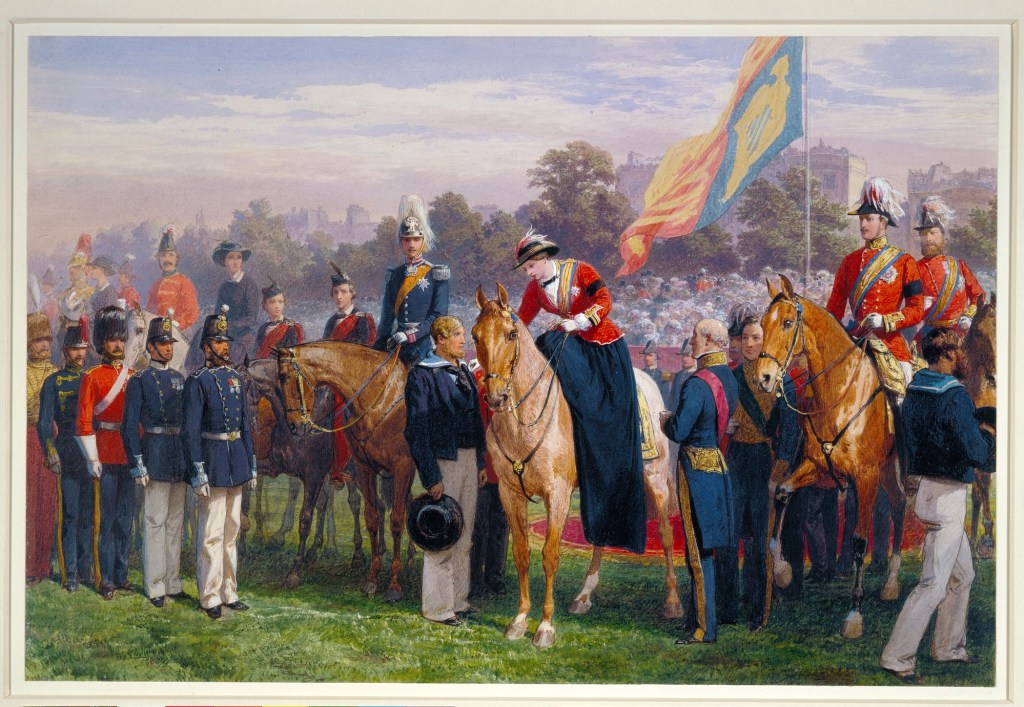
| June 26th 1857 A few minutes before 10 o’clock the officers and men who were to receive the high honour of the Victoria Cross marched in single file across the park to the Queen’s position. Their appearance created a deep sensation, and well it might, for upon a more distinguished band of soldiers the public have never yet gazed. One was a policeman, and wore his plain uniform as a constable of the R division, No. 444. This was George Walters, late Sergeant of the 49th Regiment, who highly distinguished himself at Inkermann in rescuing General Adams when surrounded by Russians. Surely for such a man a better post may be found that that of a constable at 18s a week. Another, in the dress of a park keeper, was formerly a corporal in the 23rd, who volunteered on September the 8th to go out, under a murderous fire, to the front, after the attack on the Redan, and carry in Lieutenant Dyneley, mortally wounded. Three or four were in private clothes – gallant men who have quitted the ranks since the war and have been rewarded more or less amply by civil appointments; 10 were officers and men of the Guards, and 7 were of the Rifle Brigade. There were 61 in all, of whom 12 belonged to the Royal Navy, two to the Marines, four to the Cavalry, five to Artillery, four to the Engineers, and the remainder to various regiments of Infantry. Of all 25 were commissioned officers, and the others privates and common seamen. Only one was maimed – Lieutenant John Knox, who, after greatly distinguishing himself in the Fusileer Guards, lost his arm in the attack on the Redan. As they stood in a row, waiting the arrival of Her Majesty, one could not help feeling an emotion of sorrow that they were so few, and that the majority of the men who would have done honour even to the Victoria Cross lie in their shallow graves on the bleak cliffs of the Crimea. |
| The sound of the Royal salute by the guns of the Artillery had scarcely ceased when the royal cortege, attended by the usual “brilliant staff”, came upon the ground. Her Majesty rode between their Royal Highnesses the Prince Consort and Prince Frederick William of Prussia. She wore her usual scarlet riding coat, with the General’s sash over the left shoulder, and a General’s plume of red and white feathers in her open riding hat. Round her left arm was the customary token of military mourning – a band of black crape. Prince Albert wore the uniform of a Field-Marshal, and the Prince of Prussia that of a Colonel in the Prussian service. Following Her Majesty were their Royal Highnesses the Prince of Wales and Alfred, both in the Highland costume, and wearing the small Glengarry bonnet and the eagles feather.It was evident from arrangements made that it was expected that The Queen would distribute the crosses from a table. The Queen however did not dismount, but with her charger a little in advance of the suite, with the Prince of Prussia at her right and the Prince Consort on her left, awarded the crosses from her seat on horseback. The form observed was simple in the extreme. The order was handed to Her Majesty, and the name and corps to which each recipient belonged mentioned as he presented himself. The officers and men passed before the Queen in single file, advancing close while she affixed to the breast of each in turn the plain bronze cross, with a red riband for the army and a blue one for the navy. So quietly and expeditiously was this done in every case that the whole ceremony scarcely occupied 10 minutes, and must have been over before the general but very distant public in the background were aware it had commenced. |
| The Victoria Cross was created in the aftermath of the Crimean War of 1853 to 1856. This war was the first to be covered by regular correspondents and with such modern inventions as the electric telegraph reports of the battles in this war arrived back in Britain very soon after the events were reported. At this time there was not in existence any award for bravery in battle, to remedy this situation the Distinguished Conduct Medal was instituted in 1854. This carried a pension on its award which was for the ordinary soldier and non-commissioned officers. However there was a growing awareness of the need also for an award which would be open to all regardless of rank for feats of exemplary bravery in the face of the enemy (the French, who now were our allies in the Crimea, had their Legion d’Honneur). An ex-naval officer by the name of Captain Thomas Scobell who had become a Liberal MP put forward a motion before the Commons for an ‘Order Of Merit’ in 1854. However it was The Secretary Of State For War The Duke of Newcastle who took the idea further in 1855 writing to Prince Albert about the notion of such an award. Though the Duke of Newcastle lost his position shortly after this correspondence, his successor Lord Panmure continued the process. Prince Albert and Queen Victoria took a keen interest in this new award, in the initial warrant the Civil Service proposal was to call it ‘the Military Order of Victoria’. But Prince Albert crossed this out and suggested Victoria Cross. “Treat it as a cross granted for distinguished service”, he noted, “which will make it simple and intelligible”. Queen Victoria also played a part in the design of the cross, after the first drawings had been submitted she selected one modelled on the Army Gold Cross, a campaign medal of the Peninsular War. The Queen also made a significant alteration to the motto, striking out “for the brave” and substituting “for valour”. In case anyone should come to the conclusion that the only brave men in a battle were those who won the cross. Inspired by remarks by Queen Victoria it was decided that the Victoria Cross should be of bronze composition, and so fittingly it was decided to use bronze from Russian cannon captured in the Crimean War. Although there continues a dispute to this day as the truth of this, as some maintain the cannons are Chinese from some other conflict. Whatever the source may be the gunmetal proved so hard as to resist pressing in a die as all medals are so struck from. Thus uniquely the Victoria Cross is cast instead, which does by happenstance result in better detail than die stamping is capable of. The ribbon originally was Crimson for the Army and Blue for the Navy, but since 1918 the Crimson was used for all branches of the armed forces.The Royal Warrant Instituting the Victoria Cross. Tuesday, 29 January 1856 (Public Record Office WO 98 / 1)It is ordained that the distinction shall be styled and designated the “Victoria Cross” and shall consist of a Maltese Cross of Bronze with Our Royal Crest in the centre and underneath which an Escroll bearing this inscription “For Valour”. It is ordained that the distinction shall be styled and designated the “Victoria Cross” and shall consist of a Maltese Cross of Bronze with Our Royal Crest in the centre and underneath which an Escroll bearing this inscription “For Valour” |

 Sabre Rattler